
MICHEL MARTIN, HOST:
Winter Olympians strap on skis and skates to move ever faster. For others, there’s the promise of electronic-powered sneakers. NPR’s Chloe Veltman offers this glimpse into a faster future.
CHLOE VELTMAN, BYLINE: Serena Williams, Jerry Rice and Mia Hamm all have buildings named after them at Nike’s world headquarters in Beaverton, near Portland, Oregon.
(SOUNDBITE OF ARCHIVED RECORDING)
LEBRON JAMES: Going down.
VELTMAN: In the Lebron James Innovation Center, the basketball player’s recorded voice can even be heard in the elevators.
(SOUNDBITE OF ARCHIVED RECORDING)
JAMES: Floor 1.
VELTMAN: But the company doesn’t only recognize these sports superstars as athletes.
MIKE YONKER: If you have a body, you’re an athlete.
VELTMAN: This is Mike Yonker. He heads up the team that’s developing a new type of bionic sneaker.
YONKER: It’s like an e-bike for your feet.
VELTMAN: Yonker says Nike’s Project Amplify is aimed at a broad audience.
YONKER: Amplify is designed for that everyday athlete to give them the energy they need to go further, to go faster, with greater levels of confidence.
(SOUNDBITE OF BIONIC SHOE FOOTSTEPS)
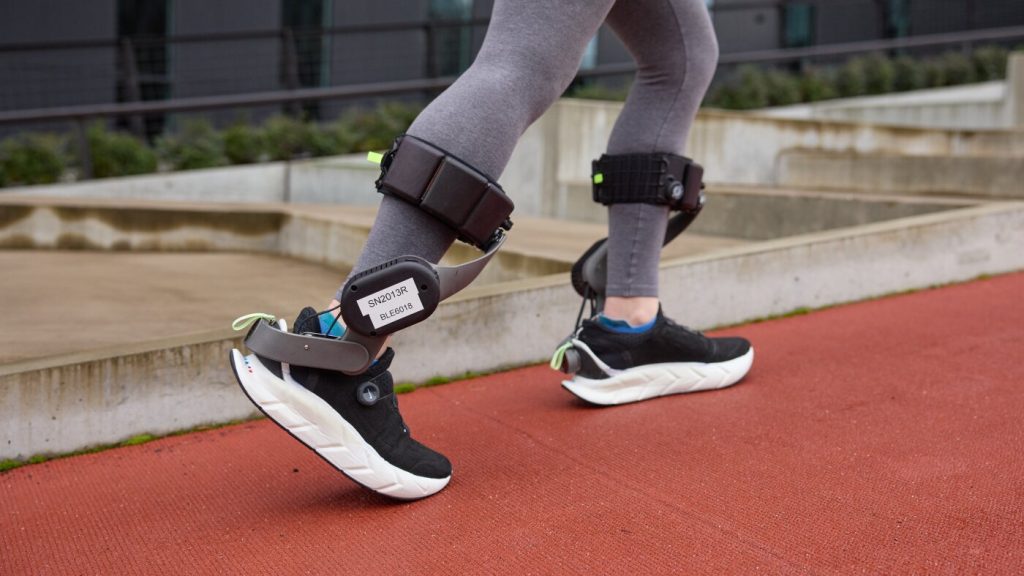
VELTMAN: The Project Amplify shoes I’m taking my first ungainly steps in on a big indoor track at Nike HQ don’t immediately inspire confidence. But the power hasn’t been switched on yet, and they’re just a prototype. Nike says it currently aims to launch the product in 2028. On my feet, a pair of fairly standard-looking sneakers with a carbon fiber plate running through the soles. Cinched to my calves, close-fitting, 3D-printed titanium shells that look like something out of “Terminator” or “RoboCop.” The battery-powered contraptions attach to the sneakers at the back. They contain complex motors, sensors and circuitry. Alison Sheets-Singer is Project Amplify’s lead scientist.
ALISON SHEETS-SINGER: What it’s doing is learning how your ankles are moving, how long your steps are, taking the algorithms and customizing them for you so that when it turns on, it feels natural and smooth.
VELTMAN: When Sheets-Singer activates the footwear system using a phone app, my legs feel a sudden hug.
Ooh. That is a most uncommon feeling (laughter).
SHEETS-SINGER: Can you describe it?
VELTMAN: Kind of feels like my feet are being pushed more aggressively forward.
ELIZABETH SEMMELHAC: The Nike Amplify comes from this long legacy of trying to increase speed and use science to help us get there.
VELTMAN: This is Elizabeth Semmelhac. She’s the director of the Bata Shoe Museum in Toronto, Canada. Says athletic shoe manufacturers initially tackled the issue of speed in the 1970s with lighter materials. Electronics started showing up in sneakers in the ’80s. The Adidas Micropacer and the Puma RS Computer Shoe used sensors to track a runner’s distance. Nike even came out with a self-lacing high top a decade ago, making real the sneakers in the movie “Back To The Future II.”
(SOUNDBITE OF FILM, “BACK TO THE FUTURE PART II”)
MICHAEL J FOX: (As Marty McFly) Power laces. All right.
VELTMAN: But Semmelhac says none of these innovations use digital technology to get the wearer’s feet moving further or faster.
SEMMELHAC: The energy needed to do something like propel a human being forward is so significant that we do not have an energy source that is small enough that can be placed within a shoe.
VELTMAN: That’s why Nike and others working on electronic-assisted footwear today, such as the Massachusetts-based startup Dephy, include leg shells to power their products. Thomas Turner is the author of the 2019 book, “The Sports Shoe: A History From Field To Fashion.” He says as the technology improves, these systems could expand people’s ability to move with greater ease. But Turner also wonders, what happens if the tech gets hacked?
THOMAS TURNER: Being strapped into a mechanism that’s possibly being controlled by some figure far off via computer networks, and you are forced to walk in places that you didn’t want to walk or do things that you didn’t necessarily want to do. That’s a bit of a weird one.
VELTMAN: No dystopian fantasies today at Nike HQ as I run up the company’s intimidating outdoor training ramp. It’s about the length of two city blocks and graded to feel like a pretty stiff session on a treadmill.
OK. Full speed ahead.
The footwear system quickly kicks into gear, picks up my heels, and propels my feet forward up the hill.
Whoo. Yeah.
Nike scientist Alison Sheets-Singer is running up in regular sneakers. I leave her in the dust.
SHEETS-SINGER: About two-thirds of the way up, it starts getting really hard, and I really wish I had assistance also (laughter).
VELTMAN: On our way back indoors, we pass by a life-size bronze statue of marathon superstar Eliud Kipchoge.
Oh, yeah, even in these shoes I would never run as fast as that fella.
SHEETS-SINGER: Neither will anyone else (laughter).
VELTMAN: I find that I’m comforted by this fact.
Chloe Veltman, NPR News, Beaverton, Oregon.
Copyright © 2026 NPR. All rights reserved. Visit our website terms of use and permissions pages at www.npr.org for further information.
Accuracy and availability of NPR transcripts may vary. Transcript text may be revised to correct errors or match updates to audio. Audio on npr.org may be edited after its original broadcast or publication. The authoritative record of NPR’s programming is the audio record.
View original article here.