
Published February 17, 2026 11:57AM
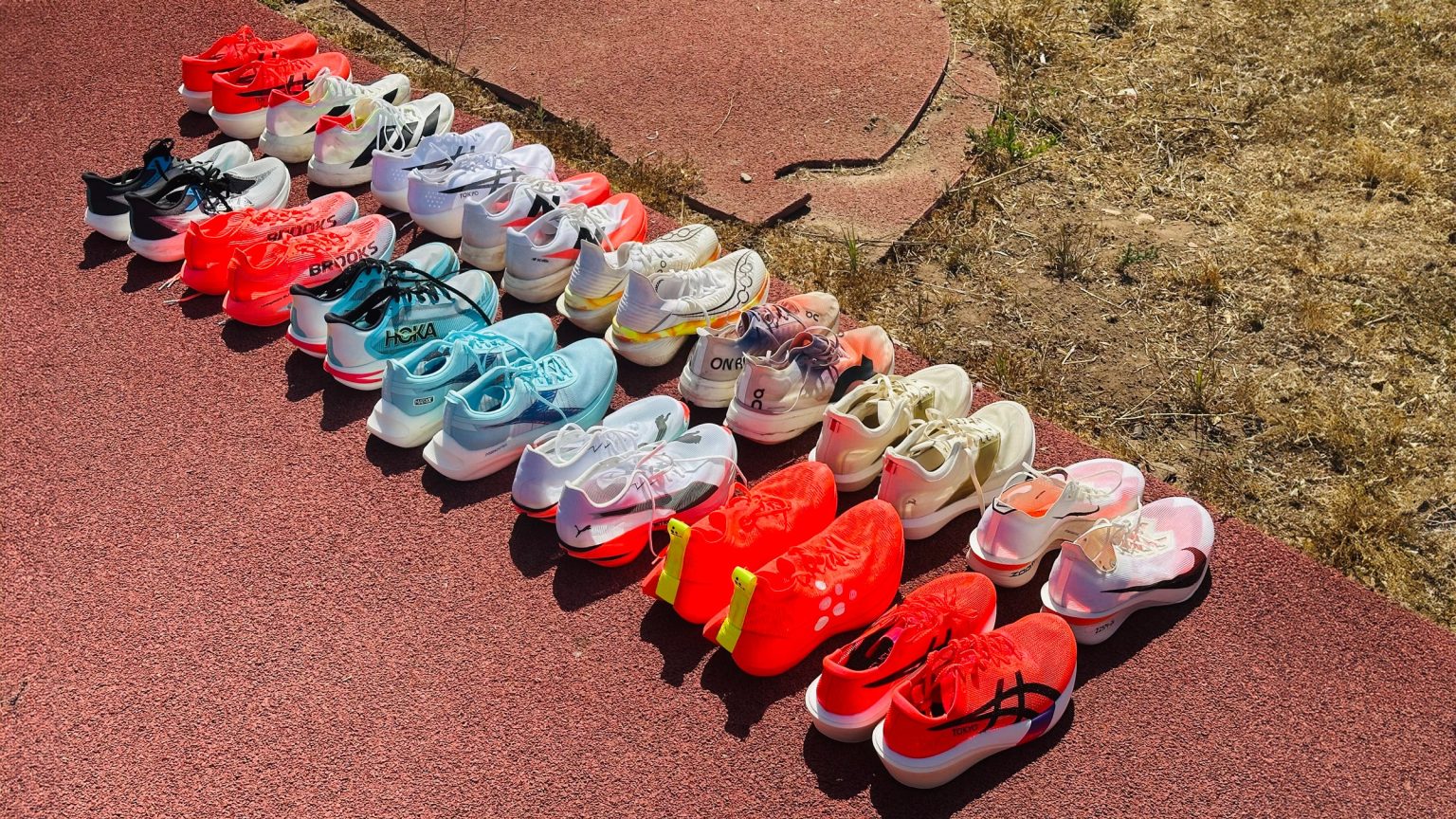
Super shoes burst on the scene a decade ago, largely because they made you fast, potentially shaving several minutes off personal bests. Runners quickly discovered, however, that the shoes’ highly cushioned soles also reduce the amount of pounding felt in races and hard training, leaving them feeling less fatigued and sore afterward. As a coach, I’ve seen runners who wore super shoes recover from marathons like they were half-marathons, and half-marathons like they were 10Ks. Their increased comfort also raises the question of whether super shoe technology might protect against injury. After all, if you aren’t pounding as much or getting as sore and tired afterward, you should have fewer injuries, right?
The science on this, however, is mixed. Most recently, a paper in the December 2025 issue of Frontiers in Bioengineering and Biotechnology by Xiaolan Zhu of Beijing Sport University, China, examined how the design of the carbon fiber plates used in super shoes impacted the biomechanics of runners’ feet and ankles. What the research revealed is, to put it mildly, complicated. Still, the latest findings and the body of research to this point could have implications for your own super shoe use.
Table of Contents
Past Research on Super Shoes and Injury Prevention
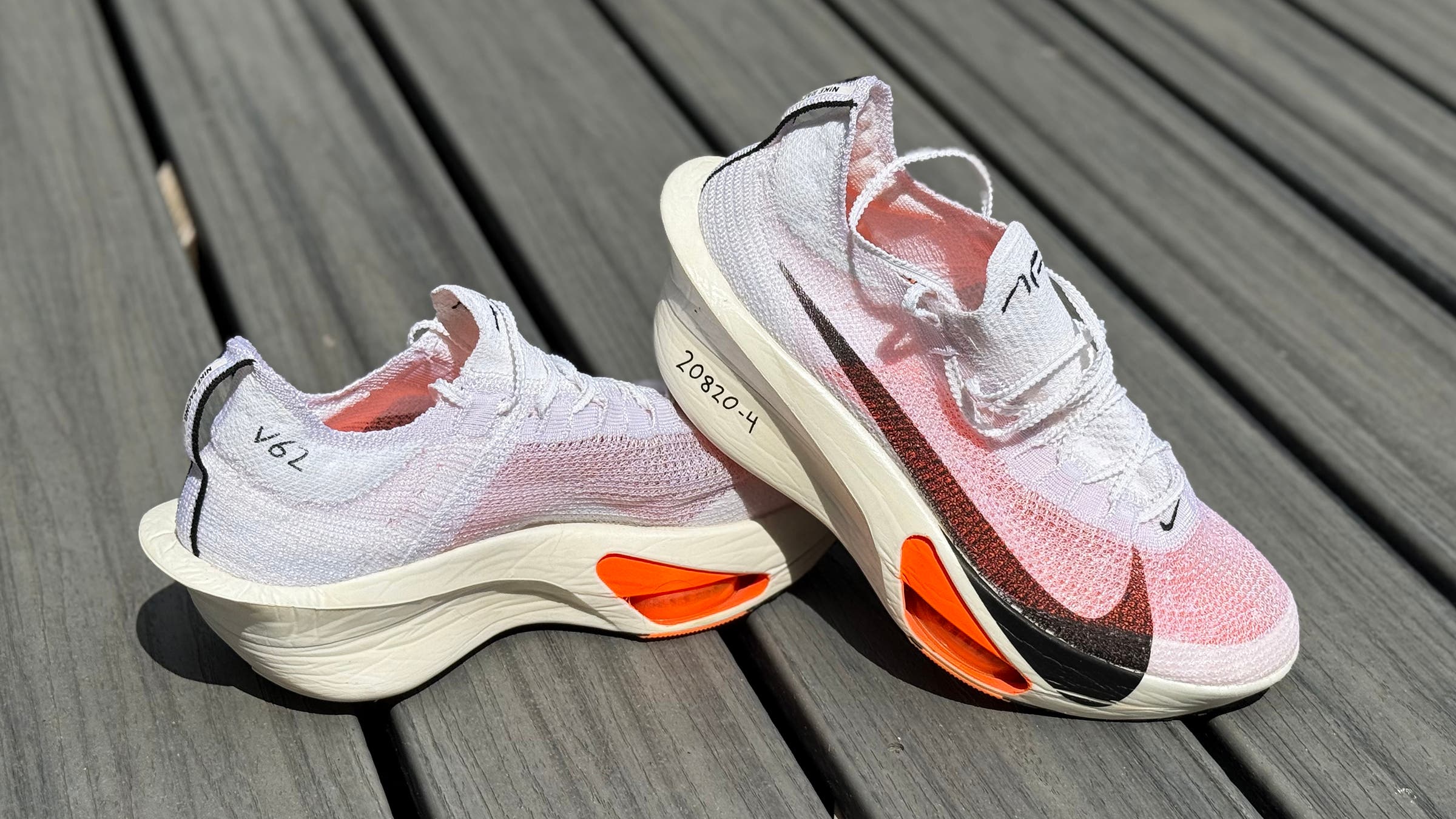
One study, reported last summer at a footwear biomechanics symposium in Oslo, Norway, recruited 195 half-marathoners and put roughly half of them in traditional shoes, and the other half in Nike Alphafly 3s. Both groups then did identical 12-week half-marathon training programs. The result, reported by Michael Ryan of the University of British Columbia and Emily Farina of Nike Sport Research Lab, was a big win for super shoes: the Alphafly 3 group had a 53% lower injury rate. That’s an eye-catching difference, though the fact that the study was sponsored by Nike “might be an issue,” says Kim Hébert-Losier, head of the biomechanics research laboratory at Waikato University, New Zealand.
Another win for super shoes (referred to by researchers as advanced footwear technology, or AFT) comes from a Swedish study, spearheaded by Toni Arndt of the Swedish School of Sport and Health Sciences and the Karolinska Institute (both in Stockholm). This study, also reported at the Oslo meeting, recruited 271 runners who were registered for the 2023 Stockholm Marathon and surveyed them weekly for 10 months prior to the race, asking about their training habits, shoe choices, and injuries. It found that even though AFT users ran 37% more distance and trained about 30 seconds per mile faster than non-AFT users, there was no statistically significant difference in their injury rates. That’s not quite as strong a finding as the Alphafly 3 study’s, but still favors super shoes, especially because none of the researchers was associated with a shoe company.
It’s Not All Good News
Not everyone’s experience, however, has been so sanguine. “Tell that to the two runners I worked with who missed the Olympics due to their new super shoes,” says Jay Dicharry, a professor at Oregon State University—Cascades, and author of Running Rewired: Reinvent Your Run for Stability, Strength, and Speed. “Or the collegiate coach who called me and said that injuries were up 50% across his team as soon as he allowed super shoes.”
Support for Dicharry’s concerns comes from a 2023 study by a U.S./German team that reported five case studies of navicular stress fractures in “highly competitive” super-shoe users. (The navicular bone is one of the bones in the top of your foot, in front of the shin. Stress fractures of the navicular are troubling because they can be slow to heal.)
Biomechanically, at least two factors might be involved.
One was found in a 2024 study in which researchers at Oregon State University and San Jose State University had a dozen competitive runners try out radically different shoes: a super shoe (the Nike Vaporfly NEXT%), and an unspecified minimally cushioned road shoe. The researchers then compared how each shoe affected the runners’ biomechanics, finding that the super shoe altered ankle motion in a way prior research had identified in runners with a history of navicular stress fractures.
The other stress factor comes from the forefoot, where Hébert-Losier says the rigid carbon plates of super shoes increase “bending moment” on the metatarsals. This translates to stretching forces farther back in the foot, including the navicular bone.
“When we are talking about repetitive stress, that would be something that could be of concern,” she says and adds that such stresses can be transferred all the way around the foot into the shin and calf, increasing injuries there.
Soft Shoes Simply Shift Stress
Other research, Hébert-Losier says, suggests that the soft, easily compressed foam of super shoes can make your ankles unstable, particularly when going around corners. This can change knee adduction (basically, the extent to which you run “bowlegs”) as well as internal hip rotation in ways that increase knee stress. The bottom line, she says, is that while shoes can be designed to minimize stress on one part of the foot and leg, ultimately, “[It] is redistributed elsewhere.”
Dicharry agrees. Whatever super shoes might do to cushion the impact from your foot strike, he says, that impact has to go somewhere. “Different materials and shoes allow us to shift where [it] goes, but it never goes away.”
Not that this is truly new. I myself frequently got hurt when a shoe manufacturer “improved” my favorite shoe, and I once took a five-day lay-off simply from doing a two-mile test of a shoe that very much did not agree with me. But, Dicharry says, “in the past [these design changes] had always been subtle. With AFT, those shifts are larger and have the potential to be more impactful.”
The Latest Study on Carbon Plates
Footwear engineers are aware of these issues and are using a battery of techniques to try to offset them.
The latest paper, authored by Xiaolan Zhu of Beijing Sport University, China, et al (who could not be contacted for this article), examined the effect of three major factors in super-shoe design, looking to see how they affect the distribution and magnitude of impact stresses and bone stresses on the bottom of the foot.
The three design factors were the thickness of the carbon-fiber plate, its degree of curvature (which, Hébert-Losier says, “can be quite dramatic”), and the manner in which its carbon fibers are aligned, which in Zhu’s study could be either parallel or woven. All told, Zhu’s team examined three plate thicknesses, three curvatures, and two types of fiber alignments, for a total of 18 different configurations, looking for how they affected the stiffness of the shoe, peak impact stress, the distribution of that stress across sole of the foot, and peak stress at each point in all five metatarsal bones.
One finding was that there was a complex relationship between shoe stiffness and the “‘thickness-weaving-angle’ triad”—a factor that could be used to help design shoes with exactly the desired level of stiffness. Equally interesting was that the interaction between the three parameters could be used to create different types of shoes for performance-oriented runners and recreational runners seeking comfort with less injury risk.
What the New Research Means for You
There are, however, a few caveats. Most importantly, says Dicharry, “this is a modeling study. Modeling studies make a lot of assumptions,”—in this case, how the tissues of the foot react to different types of plate design. “This is quite challenging to model.” And, he notes, it assumes that a shoe company experimenting with plate design will keep everything else unchanged. “That never happens,” he says.
Another issue, Hébert-Losier says, is that “biomechanical studies [such as Zhu’s] look at how the shoe moves, but that doesn’t tell us what’s happening inside the shoe, in terms of how the foot is moving inside [it].”
Benno Nigg, emeritus professor of kinesiology at the University of Calgary, Canada, agrees. “I don’t think that we (the ‘running shoe constructors’ and ‘running injury experts’) know [anything] conclusively about the [causes] of running injuries as related to shoe construction,” he says.
Meanwhile, if you are simply trying to make sense of this and trying not to get hurt, there is some useful advice.
- Don’t make sudden changes. If you are trying a radically different type of shoe, phase it in. “Your injury risk increases until you adapt,” Hébert-Losier says. Even if you try a new version of a shoe that’s worked for you, there could be subtle, unobvious changes in the construction that can significantly alter how the shoe stresses your body.
- Be aware that super shoes have a limited life. There is research, Hébert-Losier says, showing that their foam degrades faster than standard foams, and my own experience with a group that collects used shoes for the homeless is that we get a lot of very new-looking super shoes that have apparently lost their functionality. I.e., your super shoes might be worn out and a potential injury risk long before you’d expect.
- When purchasing shoes, one common piece of advice is to trust how they feel. Each super shoe differs in variables like foam density, midsole geometry, and plate angle and rigidity. It is important that you find the shoe that complements your stride. There is research to back that up, but Hébert-Losier says there are also reasons to be cautious. “We’ve recently published a study on this [and found that] how an individual feels in a shoe is highly manipulable,” she says.
That study involved doing a sham gait analysis, in which volunteers came to her lab and underwent the type of gait analysis a running store might do. “We then told them, ‘Okay, this is the shoe for you, based on what we saw,’” she says. The runners were also offered an alternative shoe, described as good, but not specifically designed for them. The catch: it was the same shoe, in a different color.
The runners were then asked to evaluate both shoes. And, Hébert-Losier says, “boy, they loved the shoe that was recommended to them and said it felt much more comfortable, would lower their injury risk, and increase performance…[even though] they’re exactly the same shoe.”
Bottom line: when trying out shoes, particularly including super shoes, where the biomechanical differences from what you are accustomed to can be particularly strong, you really, really need to ignore what even the best-intentioned salespeople say and do your best to just listen to your own body. Because, ultimately, you are the only one who can be really, truly sure what does and does not work for you.
View original article here.