
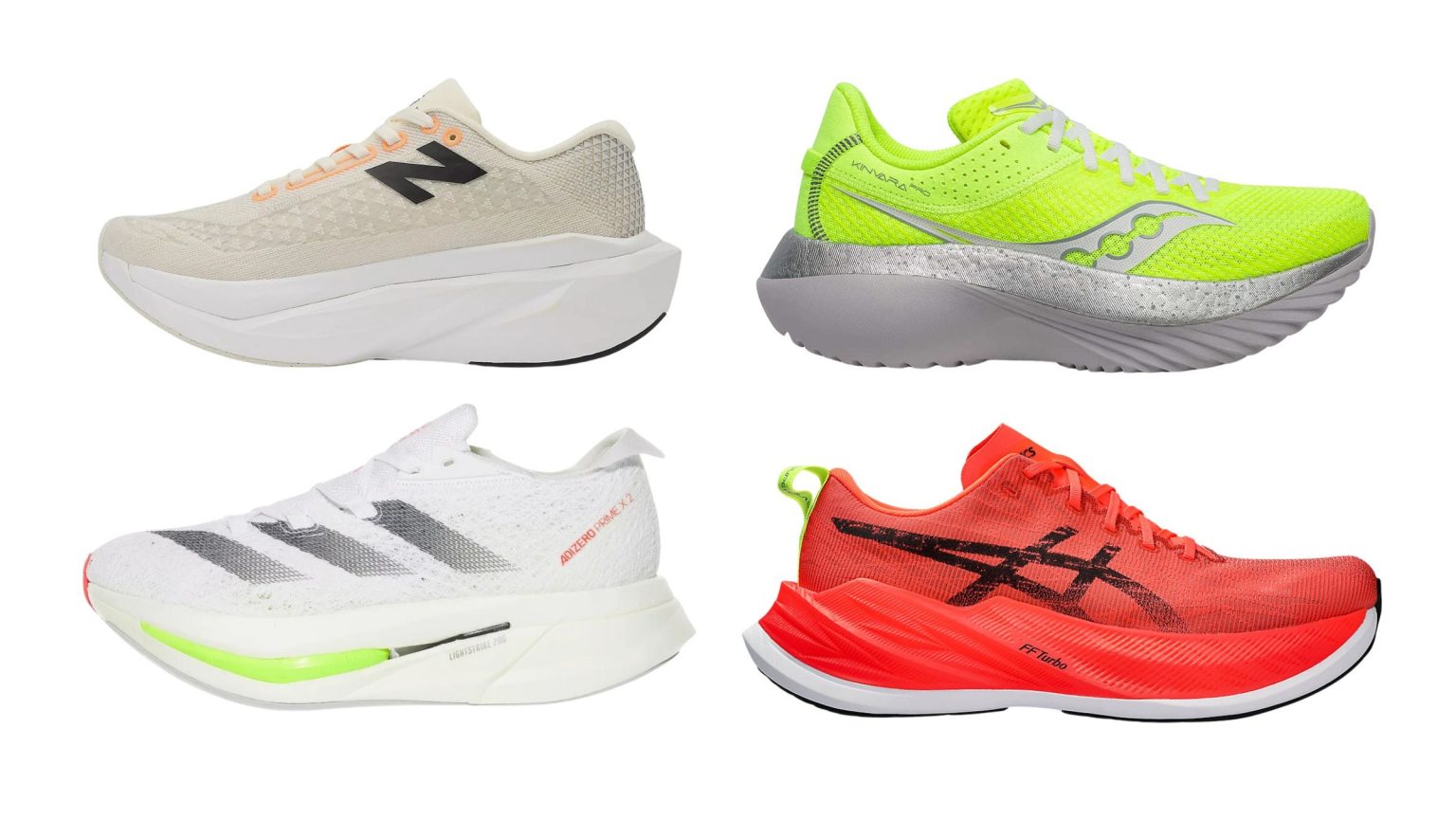
Models from Asics, New Balance, Hoka, and more have been listed as “prohibited” by Ironman for the 2025 season. Ironman head referee Jimmy Riccitello explains why.
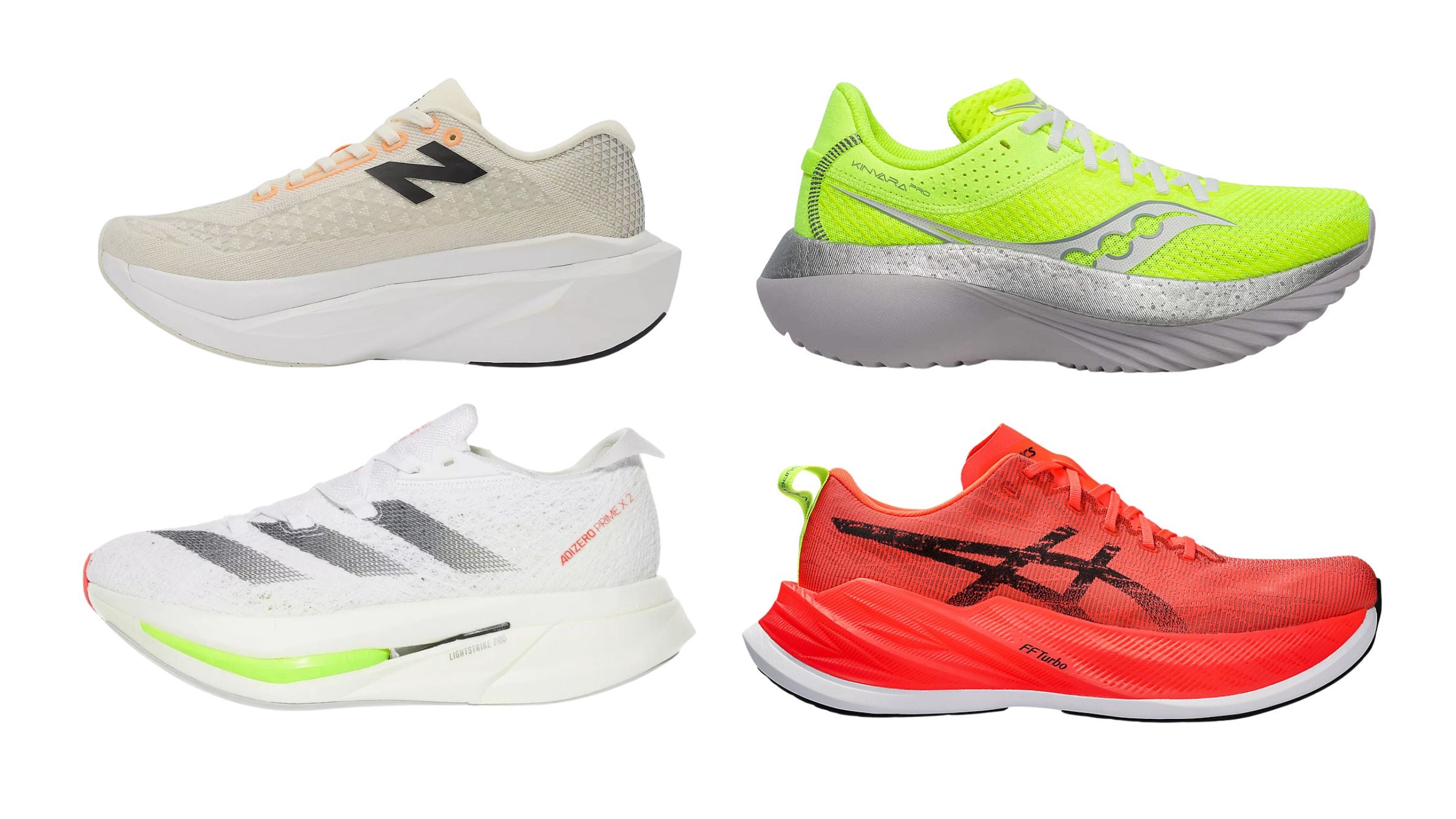
Ironman’s banned shoe list for 2025 includes the Adidas Adizero Prime X2, Asics Superblast, New Balance Supercomp Trainer, and Saucony Kinvara Pro. (Photo: Triathlete)
Updated July 10, 2025 01:50PM
If you’re doing an Ironman this year, check your running shoes before you leave T2. The race series revealed a list this week of prohibited running shoes for 2025, and several beloved brands – including the shoes pro triathlete Patrick Lange wore when he clocked his Ironman-best 2:30:32 marathon split at Ironman Israel in 2022 – are listed.
Table of Contents
Which running shoes are banned by Ironman in 2025?
As of press time, Ironman has not yet posted its competition rules for 2025 on its website, but it has released a list of banned running shoes for 2025, effective February 6, 2025 as a reference for athletes to understand which shoes do not comply with competition rules. The list includes the following makes and models, as of February 15, 2025:
All of these shoes are thicker than the 40mm stack height maximum allowed by World Athletics shoe regulations, which Ironman follows (as does World Triathlon). Stack height is determined by measuring the total height of the midsole from the ground to the insole. This measurement includes all foam, cushioning materials, carbon plate(s), and air chambers. Higher stack heights are also known as “maximal” running shoes and are popular in triathlon, especially long-course racing.
But most athletes do not go shoe shopping with calipers or other measurement tools to ascertain stack height. Ironman head referee Jimmy Riccitello says the organization released the list of banned shoes for clarity and ease of shoe selection:
“Because there are only a few shoes that are currently prohibited, we felt a list of prohibited shoes would be helpful to athletes,” Riccitello tells Triathlete. “You can find the details listed in the Ironman competition rules, but basically, any shoe thicker than 40mm or containing more than one solid plate, is prohibited.”
This means the list will likely evolve over the season, with new shoes being added to help give athletes guidance on shoe selection. Ironman also says athletes can refer to the exhaustive list of approved running shoes by World Athletics.
Why are certain running shoes banned in triathlon?
As supershoes get more “super,” researchers are finding performance advantages from mega-high soles. Simply put, the more height you have, the more efficiently one can run.
The higher the shoes, the more advantages for the person wearing them. Take, for example, the 50mm Adidas Adizero Prime X Strung Lange wore during his record-setting Ironman marathon in 2023 – 10mm over the limit and 11mm higher than the 39mm (and legal) Adios Pro Evo 1s he wore for his Ironman World Championship win in 2024.
11mm may not seem like much from a measurement standpoint (for comparison, an American dime measures 17.91 millimeters at its diameter), but shoe manufacturers can pack a lot into that small space. More foam means more energy return, and researchers have found that the materials typically used in supershoe foam compress approximately twice as much as traditional running shoes and provide about twice as much energy return to the runner. That means faster times for less effort, and not due to the runner, but the gear.
That’s not to say 40mm was established because it’s the established threshold for performance advantages. As shoe researcher Geoffrey Burns explained to Outside Run in 2021, after Vienna Marathon winner Derara Hurisa was disqualified for wearing the Adizero Prime X shoe, “the advocation to regulate shoes based on their thickness was not a suggestion that thick shoes are always beneficial, but that more and more substantially beneficial shoes are likely going to be thicker. Limiting the thickness of the shoes creates an eventual ceiling for the extent to which they can be advantageous.”
Sole thickness was of great interest to the running world as early as 2017, but largely went unregulated in triathlon. After Gustav Iden ran a 2:36:15 marathon to win the 2023 Ironman World Championship title wearing a pair of On prototypes with a midsole thicker than 40mm, Ironman took notice and issued a policy update on shoes, stating:
- Shoes with a stack height sole thickness of greater than 40mm are prohibited and will result in disqualification.
- Shoes containing more than one plate rigid structure are prohibited and will result in disqualification.
Will Ironman enforce the shoe rule for age-groupers?
Ironman’s 2024 competition rules state that pro and age-group athletes are subject to random shoe control before, during, or after any race. Any shoe that cannot be identified may be sent to the World Triathlon headquarters for verification.
The fact that prohibited shoes are being explicitly identified by brand and model also indicates that Ironman may be more likely to police based on visual ID rather than measuring a shoe’s stack height (which is logistically unrealistic).
“At an event, referees do not inspect shoes or go looking for prohibited shoes,” Riccitello says. “However, if evidence is provided that an illegal shoe may have been used, a head referee will investigate. If an illegal or prohibited shoe was used, the athlete will be disqualified.”
What about prototypes?
The Ironman World Championship is often a place where prototype shoes are spotted for the first time. Most famously, Iden’s, but there are others. Jan Frodeno won the 2019 Ironman World Championship in a prototype for Asics which featured its first carbon plate; in 2022, Joe Skipper and Lisa Norden, among others, were spotted wearing Hoka prototypes. Daniela Ryf also wore Hoka prototypes in 2023, and was joined by Chelsea Sodaro in prototype Ons.
All of these shoes were cleared with Ironman, and Riccitello says they will continue to accept prototype shoes so long as they are approved under World Athletics standards:
“Prototype shoes must be World Athletics approved as explained in their ‘shoe rule.’ We have had a couple of pros using prototype/new shoes and their shoe sponsor went through the correct process to have the shoe World Athletics approved.”
View original article here.