
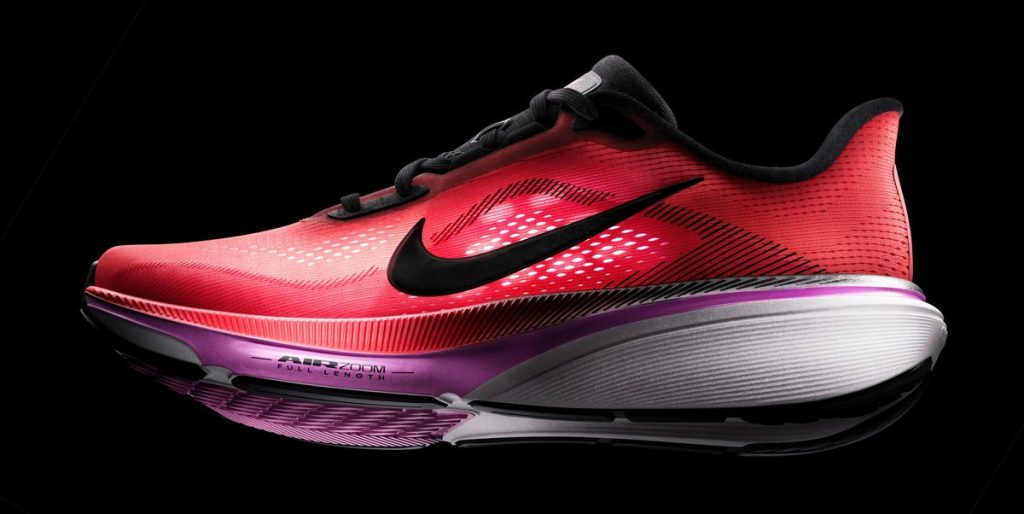
It has been a couple of years since the Pegasus 41 was launched and in that time Nike has doubled down on promoting a trifecta of shoes for all runners – the Pegasus, Vomero and Structure. While the other shoes in the line-up have had recent updates, the Peg has been due one and it is finally here – and by Pegasus standards, it’s quite significant.
On the things that haven’t changed, the stack height has remained the same and is a 10mm drop with a 37mm stack at the heel and 27mm at the forefoot. The reason the stack has remained the same is that Nike claims that it wants to keep ground feel as a key component to this shoe, especially as the Vomero offers 9mm more stack and that’s before we talk about the Plus and Premium versions of the shoe. They want the Pegasus to feel ‘nimble’ and we hope that this is the case. The Pegasus 42 continues to use ReactX foam in the midsole and that’s about it.
As for the changes, a major one in version 42 is the shape and construction of the midsole, which has allowed Nike to get 3mm of extra foam under the toes, meaning more cushioning at the front of shoe (more on that later on). How do you get an extra 3mm under the toes without changing the stack height?
The last for the Pegasus 42 (the mould the shoe is made from) is a new last and according to Nike, it’s 90% the same as the previous last, but that 10% difference can be found at the front of the shoe. With more toe spring built into the design (think lifted toes), there is more space inside the shoe for more foam without changing the stack height. This also compliments the changes that Nike has made to the air unit.

The air unit is the big update – previous versions had an airbag at the heel and the forefoot, but the Pegasus 42 has a full length airbag for a more consistent feeling of cushioning. Also, the air unit is curved in shape, not dissimilar in shape to that of carbon fibre plates used in shoes, which Nike claims assists a feeling of propulsion. The air unit is also the most tuned air unit that Nike has ever made. What does that mean? Well, the air unit changes in size, grade, pressure and height with the shoe sizing, so large shoes have bigger air units with higher pressure. We believe that this has been done in the hope that the ride experience is more uniform for all runners, regardless of shoe size – but only logging some miles will tell otherwise.
Other changes are a moulded foot bed due to the new shape of the shoe, a marginally wider toe box, a new engineered upper with midfoot band for a more locked in feel and a ‘mini waffle’ outsole.

With the extra foam under the toes, toe spring being built into the shape of the shoe and a curved air unit, the assumption would be that the Pegasus is still being sold as the go-to training shoe for runners looking for a lighter, faster shoe – a shoe that feels more responsive and controllable when running with effort than it’s more stacked counterparts. We’ll come back to that once samples have arrived.
There will also be Pegasus Plus and Pegasus Premium models coming soon, with the Plus focusing on more cushioning and the Premium on a more performance/experimental design (bring back the Peg Turbo 2!).
View original article here.