
Hi everyone, welcome back to SportsVerse, my twice-weekly newsletter that tells stories you can’t find anywhere else about the intersection of sports, fashion, business, and culture.
You’ll have noticed there was no Tuesday newsletter this week. That’s because I’ve been in South Korea reporting on today’s story, which includes insights from interviews with On co-founders Caspar Coppetti and Olivier Bernhard and chief innovation officer Scott Maguire, who had details to share on the brand’s latest technological development, an innovation which they believe will radically alter the future of athletic sneaker production for years to come. Enjoy.
For a few years now, executives and a close-knit team of engineers, designers and scientists at Swiss sneaker giant On have quietly been developing a patented innovation that they believe could one day revolutionise how the brand, and perhaps the entire sportswear industry, approaches sneaker manufacturing.
Yesterday, at a secretive factory building on the outskirts of Busan, South Korea’s second largest city, On revealed in no uncertain terms its belief that that day had arrived.
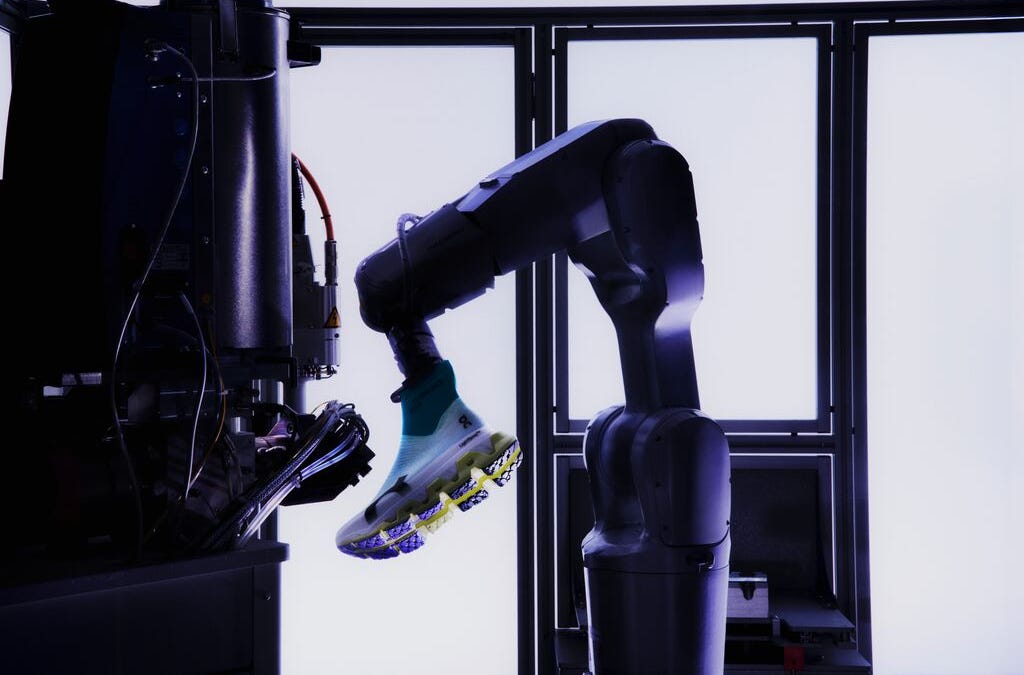
Entering the newly opened facility, its hard not to be struck by the contrast of the nondescript facade and the sleek, ultramodern and scientific scene that greeted me on the inside, where 32 fully automated robots worked in perfect harmony—while other robots shuttled prototypes to and from different workstations—creating unit after unit of the LS Cloudmonster 3 Hyper, the first performance running shoe that On will make at scale for the mass market using its robotic LightSpray tech.
The evolution of the modern sneaker industry has been marked by various innovative breakthroughs that each changed the look and feel of our footwear as we know it. For example, Nike’s Flyknit or “Air” technology, Adidas’ Ultraboost foam, and more recently On’s unique CloudTec midsole. While LightSpray—just like the aforementioned developments—will also set out to transform the look and feel of footwear, its value extends far beyond just that.
“We’re not the first brand to try automation, but we’re the first to succeed and do it at scale”
The technology—a robotic arm which sprays on an ultrathin upper in a matter of three minutes—is truly a sight to behold, and one that is already transforming the company’s footwear development process, from concept to production. “We are not just shoe designers now, we are robot designers,” said On co-founder and former triathlete Olivier Bernhard. These robots simplify the process of sneaker manufacturing, which typically is a cumbersome process with over 200 manual steps and considerable material wastage from fabric cutting.
On has been ramping up the LightSpray production capabilities since soft launching the technology on the eve of the Paris Olympics in 2024, where it gained instant credibility and exposure, later going on to help Hellen Obiri break records at the New York Marathon last year. In July 2025, it opened its first LightSpray facility in Zurich, which contains four robots focused on producing a limited number of its Cloudboom Strike LS long distance racing shoes.

The new Busan facility has increased On’s production capacity 30-fold, albeit from a small base. It now means that the 32 robots in the Busan facility have a production capability in the hundreds of thousands of units, allowing On to move at a speed, scale and level of efficiency that is simply unprecedented in the footwear industry, which is notorious for having two-to-three-year lead times on new footwear lines. In contrast, the new LS Cloudmonster Hyper (a premium running shoe intended for the mass market) was in the works for just six to nine months between concept and production.

Table of Contents
How Does It Feel To Create NYC Marathon-Record Breaking Shoes? Find Out From the Man Himself
“We’re not the first brand to try automation [of sneaker manufacturing], but we’re the first to succeed and do it at scale,” said co-founder Caspar Coppetti, speaking to me at the factory as the robots worked away in the background.
It’s fortuitous timing, too. The brand is expected to reveal another bumper set of financial results next week when it reports its 2025 earnings, with analysts and insiders confident it cleared annual revenue of $5 billion for the first time in its 15 year history, marking yet another year of double digit sales growth.
Innovation (or lack thereof) has long been a topic of intense interest to investors and analysts concerned with the sportswear market. (After all, it was a perceived lack of innovation at Nike—among other things like sliding sales and vanishing profits—in its Donahoe era that led to the company’s stock being hammered over the past 18 months.)
The scaling up of LightSpray is an additional positive catalyst that will be sure to encourage investors on the prospect of On’s quest to surpass rival sportswear brands that just a couple of years ago would have towered over it (such as struggling Puma, or the equally fast-growing New Balance), but now sit firmly within its crosshairs.
On is by no means stopping in Busan. The company is already exploring further LightSpray facilities elsewhere in Asia, as well as in North America and in Europe, in its quest to nearshore production and localise creation to meet the different needs of each market. “Within months we can replicate this anywhere in the world,” Coppetti said.
One thing that struck me was the speed of the whole operation. Not only the fact that one robotic arm can create a shoe in three minutes, but also the speed at which On was able to develop its LightSpray robotic technology and bring it to market at scale.
On benefits from being a far younger company than many of its competitors, with intentionally clear and direct lines of command between the relevant on-the-ground teams and the three founders.
“At the very core, we are an innovation company, and that’s where all the founders spend our time,” said Coppetti. “We own a large part of the company, we [still] have a controlling shareholding, so we’re able to take risks. We can tell our teams: ‘Go for this; don’t go for that. Don’t settle for compromise, but go bold.’ So we’re taking the pressure off middle management having to make maybe uncomfortable decisions by giving them very clear direction.”
The founders’ interest in product and innovation goes far beyond savvy management strategy. Bernhard, for example, a former world champion triathlete, told me at the factory that he had run over 1000 kilometres in a prototype pair of the new LightSpray sneakers to ensure its quality and durability. It speaks to the level of involvement the brand founders have maintained since the early days, when they would travel around the world with their CloudTec running sneakers to convince retailers in person to try on their unconventional-looking shoes for a run in the hope they would place an order for their product directly after. It’s a formula that’s paying dividends to this day.
As monumental a breakthrough as it is, working out how to scale LightSpray production was only half the battle. The remaining challenge will be convincing consumers (both in running and in lifestyle) of the appeal of the laceless, sock-like sneakers produced with the new technology.
It certainly wouldn’t be the first time On has had to penetrate the market with a highly unconventional silhouette. The brand’s entire success story was based on the popularisation of shoes that in their early years were ridiculed for their bizarre, holey midsoles and springy feel underfoot. (A decade later, and with On at close to $5 billion in annual revenue, the only people still laughing are those at company HQ in Zurich, all the way to the bank.)

On wouldn’t be the first company to try to make a sock shoe a global hit. Balenciaga famously turned its version of a similar silhouette into an (albeit fleeting) success story in the not-too-distant past. But On has a different task altogether: convincing notoriously picky runners and notoriously suspicious fashion consumers that the future of performance footwear looks and feels completely different to what they are used to. That’s no small task.
The brand has plans to drive demand around the new silhouette via limited edition fashion collaborations. Coppetti confirmed two collabs are already in the works, but declined to go into further detail. I imagine one will be with the brand’s first (and highest profile) partner, the luxury fashion house Loewe, while the other may target a more streetwear-focused crowd via Japanese royalty Beams or Korean label Post Archive Faction.
On has conviction that the LightSpray-designed shoes can change the footwear industry in the same way that the iPhone revolutionised the look and feel of technology as we know it. Time will tell. Since its founding, the company has seen itself akin to companies like Apple or Dyson, far more so perhaps than its sportswear rivals.
“We will never lose the mindset of being a challenger brand, even if the day comes that we are surpassing Nike.”
Coppetti added that the current output of LightSpray is only at 3 to 4 percent of its total capacity, and its capabilities already go far beyond the new LS Cloudmonster Hyper silhouette that it’s currently focused on producing. This strategy allows the brand to penetrate the market with one key style and silhouette, just as it did 15 years ago with its original CloudTec sneakers, before diversifying into other lanes after gaining traction.
After spending more than 48 hours with the founders and the team who built LightSpray from the ground up, what struck me the most was their shared joy in being the underdog, in taking great risks and in strating from scratch, even as the business enters a phase of maturity that’s a far cry from its origins as the new kid on the block in the industry not that long ago.
Bernhard compared it to the joy and freedom he felt as a young athlete gunning for medals or records, compared to the pressure he felt later on in his career when he was the one with a target on his back.
“We will never lose the mindset of being a challenger brand, even if the day comes that we are surpassing Nike,” he said with a broad smile.

On Is Becoming a Sportswear Giant, Not Just a Running Brand

Sportswear Marketing Is Getting Nicher by the Day

Why On Is Entering Football

On Changed Running Forever. Then It Came for Tennis.
That’s all for today, friends. Thanks for coming along for the ride.
See you soon,
DYM
View original article here.